An aluminium cruiser from workboat builders in Italy? Jochen Rieker sails this modern design to see which sailors it suits
Product Overview
Product:
Stem 50 review: Top-quality adventure yacht
Manufacturer:
Adventure YachtsTAGS:
More and more sailors are not just dreaming about but actually planning extended cruises to far-away places. While the majority may take any GRP boat across the Atlantic or into high latitudes – usually the yacht they already own – some will opt for a purpose-built, more forgiving, more utilitarian craft.
Aluminium explorer and bluewater yachts have thus become somewhat of a trend. In fact, they represent one of only a few booming market segments. New yards and their innovative designs are complementing the dozen or so speciality builders from France and the Netherlands who still have a stronghold in this growing niche of the sailboat market. Now Italy has joined the party.
The Stem 50, which premiered at last year’s Genoa Boat Show, offers yet another interpretation of a 4×4 for the high seas, the latest of the recent alu breed. And while few sailors may have heard of the brand, its builder is anything but a newcomer. In fact it’s recognised internationally for its purpose-built workboats.
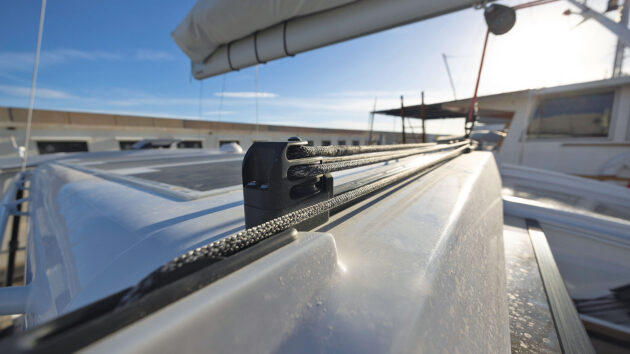
Practicality is key here: mainsheet kept out of the cockpit on the rollbar. Photos: Andreas Lindlahr/EYOTY
For 40 years, Stem Marine, founded by Ezio Menna in Medesano near Parma, has produced rescue, patrol, and firefighter boats to the highest industrial standards. With a staff of 85, they also developed evacuation systems, stretchers, and shock-absorbing pilot seats.
That same engineering prowess and artisan excellence has now shaped a 15m go-anywhere yacht, one where “every detail has been conceived and crafted with the utmost care and precision”, as managing director Michele Corradi puts it.
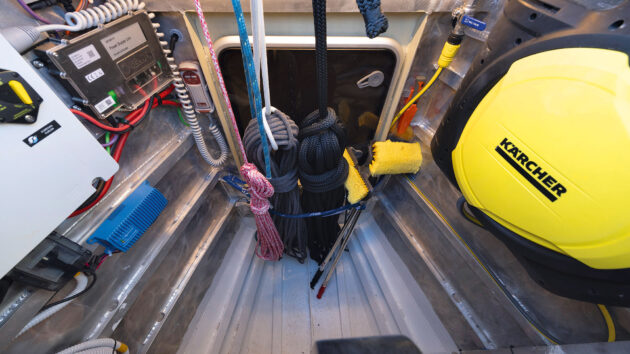
A good size watertight bow locker. Photos: Andreas Lindlahr/EYOTY
While the vision to venture into sailing goes back some 20 years, it wasn’t until 2022 that Corradi tasked Nicolas Purnu, a French naval architect formerly with Marc Lombard Design, with this project. Last summer’s launch followed three years of development – a lead time that is testament to the thoroughness of Stem’s approach.
And it shows. From deep down in the watertight aft compartment to the meticulous electrics installation, this boat doesn’t take anything lightly. She means business.
Her dual autopilot set-up, for instance, follows IMOCA standards: it provides full redundancy, allowing you to switch from starboard to port unit within an instant – no other action required than turning a knob on the control panel.
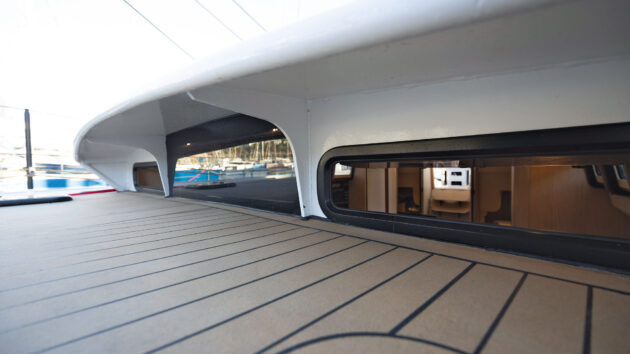
Coachroof overhang cuts glare to saloon windows. Photos: Andreas Lindlahr/EYOTY
Aircraft quality
The attention to detail continues: the forward sail locker isn’t just a big, deep cavity in the deck – there are shelves, welded so they can be used as a ladder that at the same time help you properly put away fenders, ropes, and the furled Code 0 instead of dumping everything in a pile.
Or take the top shelves in the saloon. They’re made from milled, machine-bent and welded aluminium sheets, as used on commercial aircraft, carrying up to 20kg of load each. Hinged and dampened to safely open downwards, they won’t spill whatever is stored inside. Why, you wonder, has no other yard done it this way?
The list of clever details could easily fill pages, and we’ll highlight a few more later on. Instead of playing it safely, staying inside of what is proven, the yard presented one of the most elaborate new builds in years.
Michele Corradi calls the 50 “a unique yacht for discerning sailors who seek something beyond what traditional production boats can offer.”
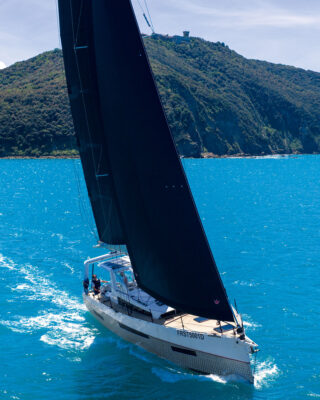
Large genoa provides plenty of power upwind and makes the Stem 50 a joy to sail in light to medium breeze. Photo: Luca D’Ambrosio
Hard lines
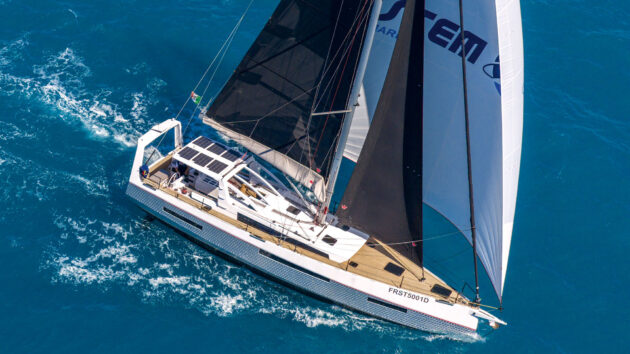
Fittingly, the Stem 50’s hull lines look different to most of the competition. Chamfered topsides make for a sporty appearance, highlighted by the white paint that contrasts nicely with the otherwise bare aluminium, polished to a half-moon pattern.
Seen powered up in the breeze from the front or the side, she could be mistaken for a performance cruiser. Her fine entry and slender bow mask the volume she carries from amidships to the stern. The aft section, however, comes across as mighty as that of a freighter with the nearly vertical transom and the big roll bar towering above the deck.
While boat number one sports all the extras available for the cockpit layout, including a rigid hardtop and the arch aft, the Stem 50 in standard configuration only comes with the targa-bar above the companionway, which carries the traveller. That gives her a lighter, more elegant, less functional character than the test boat.
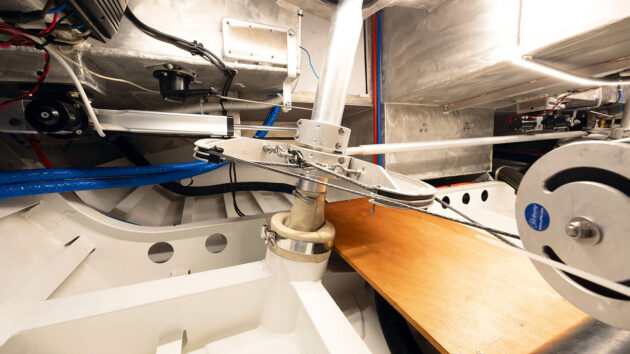
Rudder feedback is excellent, as is the engineering of systems. Photo: Luca D’Ambrosio
Yet, without the hardtop, you give up on another unique feature: fully retractable rigid sprayhood windows that open and close at the touch of a button. There are three segments to be operated individually, sliding into the hardtop roof for maximum cockpit ventilation.
It does come at a price, though: The rigid bimini sets you back €53,000, the servo-actuated polycarbonate windows another €13,500. Having experienced the feature during a week of testing off the Catalan coast with temperatures as high as 35° at times, it does feel tempting to tick those boxes anyway.
The cockpit itself is spacious enough to seat six to eight people. Benches measure a generous 2.06m and are separated by a solid aluminium table base with drop-down leaves to either side, complemented by many storage shelves and boxes for crew gear.
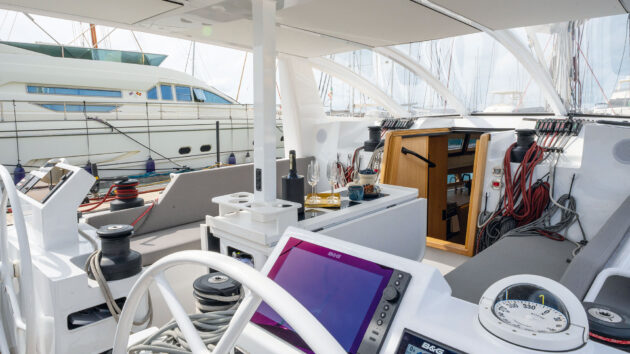
Cockpit gets busy with full crew. Sheet loads on the primaries next to the pedestals suggest an upgrade to electric winches. Photo: Luca D’Ambrosio
The backrests are nearly vertical, so not the most comfortable on long passages. But they are high enough to give a feel of protection,